
The intelligence layer behind aviation decisions.
AeroFarr fuses live surveillance, weather intelligence, and years of flight records into calibrated forecasts, verified causal chains, and executive-ready briefings. The picture re-scores continuously.
Overview
AVIATION INTELLIGENCEWhere legacy platforms report what happened, AeroFarr identifies why, and what to do about it. At its core is a multi-agent architecture: specialized reasoning agents for disruption forecasting, causal explanation, network-cascade analysis, scenario simulation, and aviation-safety knowledge, orchestrated to reason about the national airspace together. Trained on more than 100 million public-domain flight records and grounded in a deep NTSB and ASRS safety corpus, it converts scattered data into decision-grade intelligence, delivered through an explainable enterprise experience and API.
Calibrated by design
Every forecast ships with honest uncertainty bounds. Conformal calibration states how confident the model really is.
Causal, not correlative
A causal inference engine traces the actual mechanisms behind disruptions: verified chains, not statistical coincidence.
Network-aware
Graph models capture how disruption propagates across the national airspace through aircraft rotations and dependencies.
Live by default
The operational picture re-scores continuously, fusing surveillance, weather, and traffic management.
Capabilities
What the platform doesSee disruption before it reaches the gate.
Machine-learning forecasts for delay, cancellation, and diversion, trained on years of real operational records and scored against live conditions. Forecasts arrive hours ahead, with calibrated intervals instead of false certainty.
- Pre-departure risk scoring
- Conformal, honest uncertainty intervals
- Continuous re-scoring against live data
From correlation to cause.
A do-calculus causal engine identifies the mechanisms behind disruptions and supports counterfactual questions: what would have changed if the ground stop lifted an hour earlier, or the swap happened at the previous rotation.
- Verified causal chains
- Counterfactual what-if exploration
- Prescriptive recovery options
Know which flights are affected next.
Graph neural networks model the airspace as a living network of aircraft rotations, crew dependencies, and hub topology, so one disruption's downstream footprint is visible before it lands.
Ask the safety corpus. Get cited answers.
Natural-language retrieval over a large corpus of federal safety reports, with semantic search and synthesized, source-cited answers in seconds. Safety intelligence that used to take analyst-days.
Briefings written for the decision, not the dashboard.
Context-aware intelligence briefings synthesize the operational and safety picture into executive-ready narratives. Every claim traces back to the underlying flight, weather, and safety records that produced it.
Every critical feed. One operational picture.
Federal, public, and proprietary streams fused into a single calibrated picture that no individual source can show: FAA SWIM flight and flow-management feeds (SFDPS, TBFM, TFMS), NASA DIP trajectory archives, continuous ADS-B surveillance, METAR, TAF and NOAA weather models, years of DOT and BTS performance records, a quarter-million-report safety corpus embedded for semantic search, and NOTAM, PIREP and SIGMET advisories distilled into structured risk signals.
The picture re-scores every sixty seconds. Four proprietary engines run on top of it: distributional mixture-of-experts prediction, a causal do-calculus engine, temporal graph cascade models, and RAG safety intelligence, all wrapped in conformal calibration.
Architecture
How the system is wired · flows animate liveFrom the Platform
Live product · aerofarr.com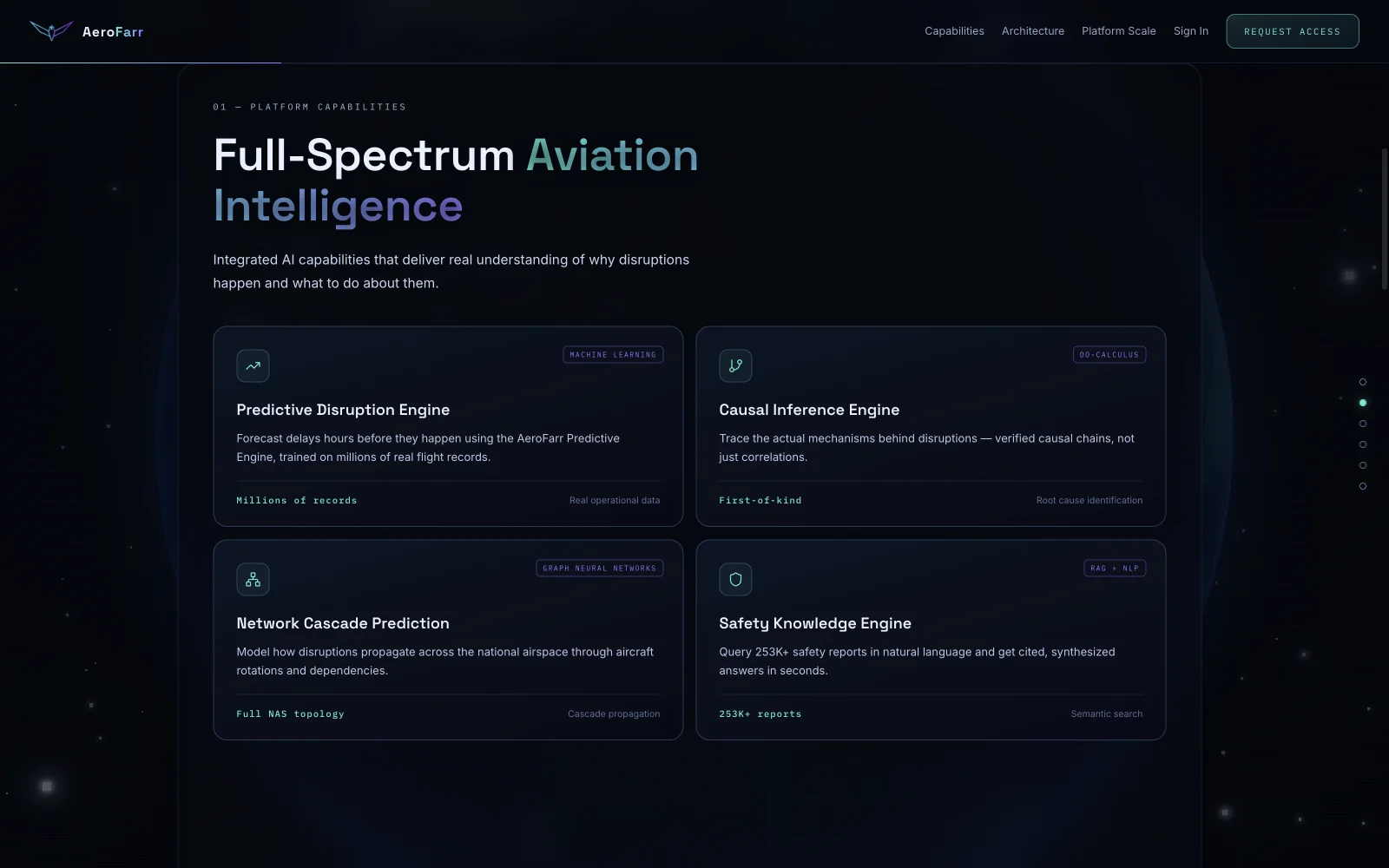
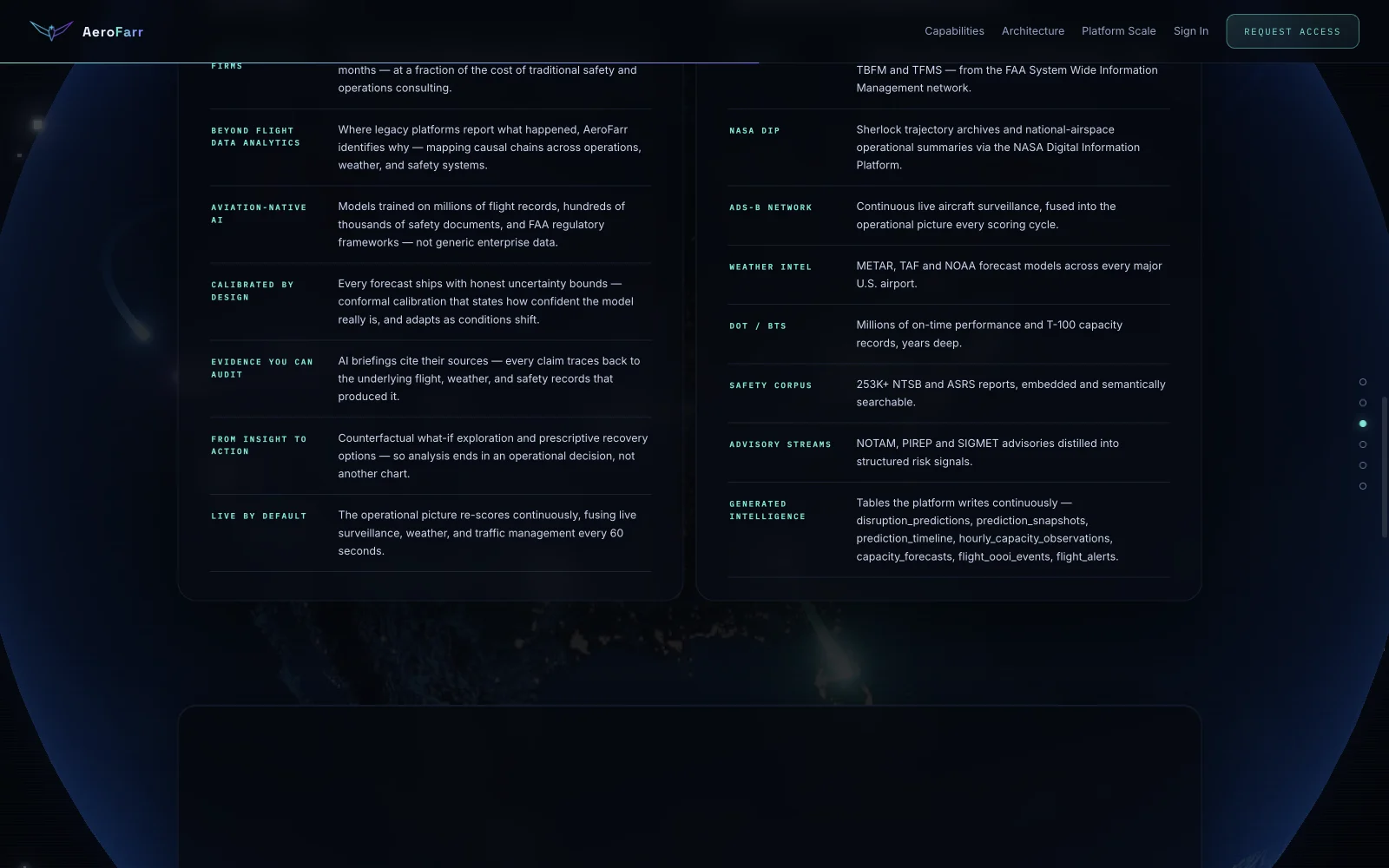
Beyond dashboards. Beyond consulting. Aviation-native intelligence.
Impact
Aviation Intelligence · 11 publishedHow aircraft types are classed: a public lexicon
Airliners and general aviation, as types
Helicopters, fighters, and attack types: public identity only
AeroFarr Is Live, Disruption Intelligence That Explains Itself
Why Calibration Matters More Than Accuracy: an ECE 0.012 Story
NOTAM, PIREP, and SIGMET as Structured Risk Signals
A Retrieval Engine over the World’s Aviation Safety Corpus
The Rotation Is the Unit of Prediction, Not the Flight
Work With Us
Briefings · federal · productQuestions, answered
AeroFarr · common questionsWhat is AeroFarr?
AeroFarr is a Zorost Intelligence platform for aviation. AeroFarr fuses live surveillance, weather intelligence, and years of flight records into calibrated forecasts, verified causal chains, and executive-ready briefings. The picture re-scores continuously.
What can AeroFarr do?
AeroFarr is built around a few core ideas: Calibrated by design (Every forecast ships with honest uncertainty bounds. Conformal calibration states how confident the model really is.) Causal, not correlative (A causal inference engine traces the actual mechanisms behind disruptions: verified chains, not statistical coincidence.) Network-aware (Graph models capture how disruption propagates across the national airspace through aircraft rotations and dependencies.) Live by default (The operational picture re-scores continuously, fusing surveillance, weather, and traffic management.)
Is AeroFarr a live product, and can it run in our environment?
Yes. AeroFarr runs in production, and you can see it at aerofarr.com. Zorost also engineers AeroFarr-class capability directly into client environments.
How do we get started with AeroFarr?
Start with a briefing. Zorost maps your operation, shows what AeroFarr already does in aviation, and scopes a first phase. Contact [email protected] or ask the concierge on this page.
Visit us. Visit AeroFarr.
Disruption forecasts, causal chains, and safety intelligence, live on the platform.
aerofarr.com>>Serving those who
need to stay ahead.
We don't pitch slide decks. We show you what we've already built in your domain, then engineer what your mission requires.