
Ontology Governance, the Semantic Layer AI Actually Needs
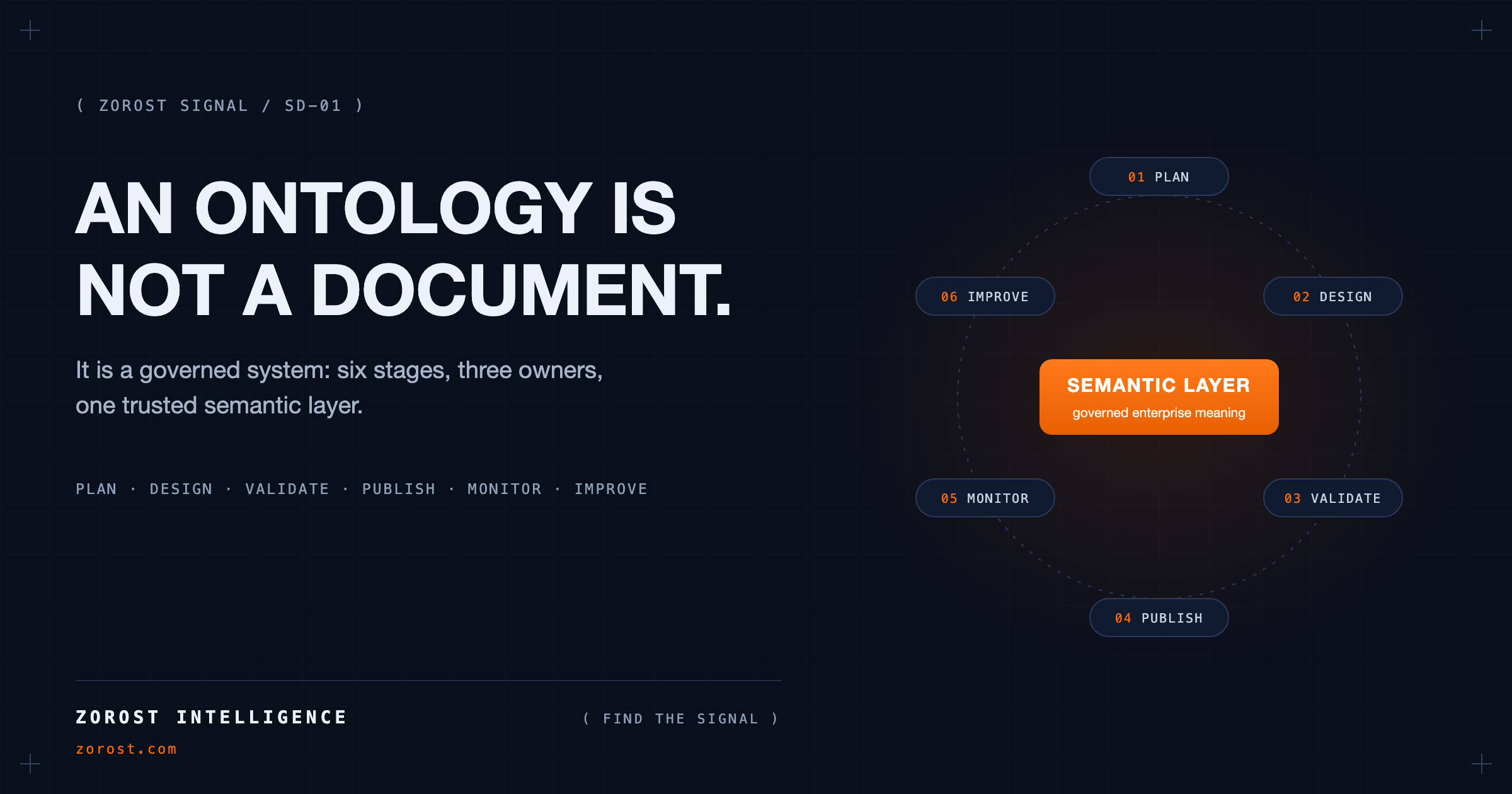
Pull-quote: “Ungoverned meaning is where trustworthy AI quietly breaks, long before anyone blames the model.”
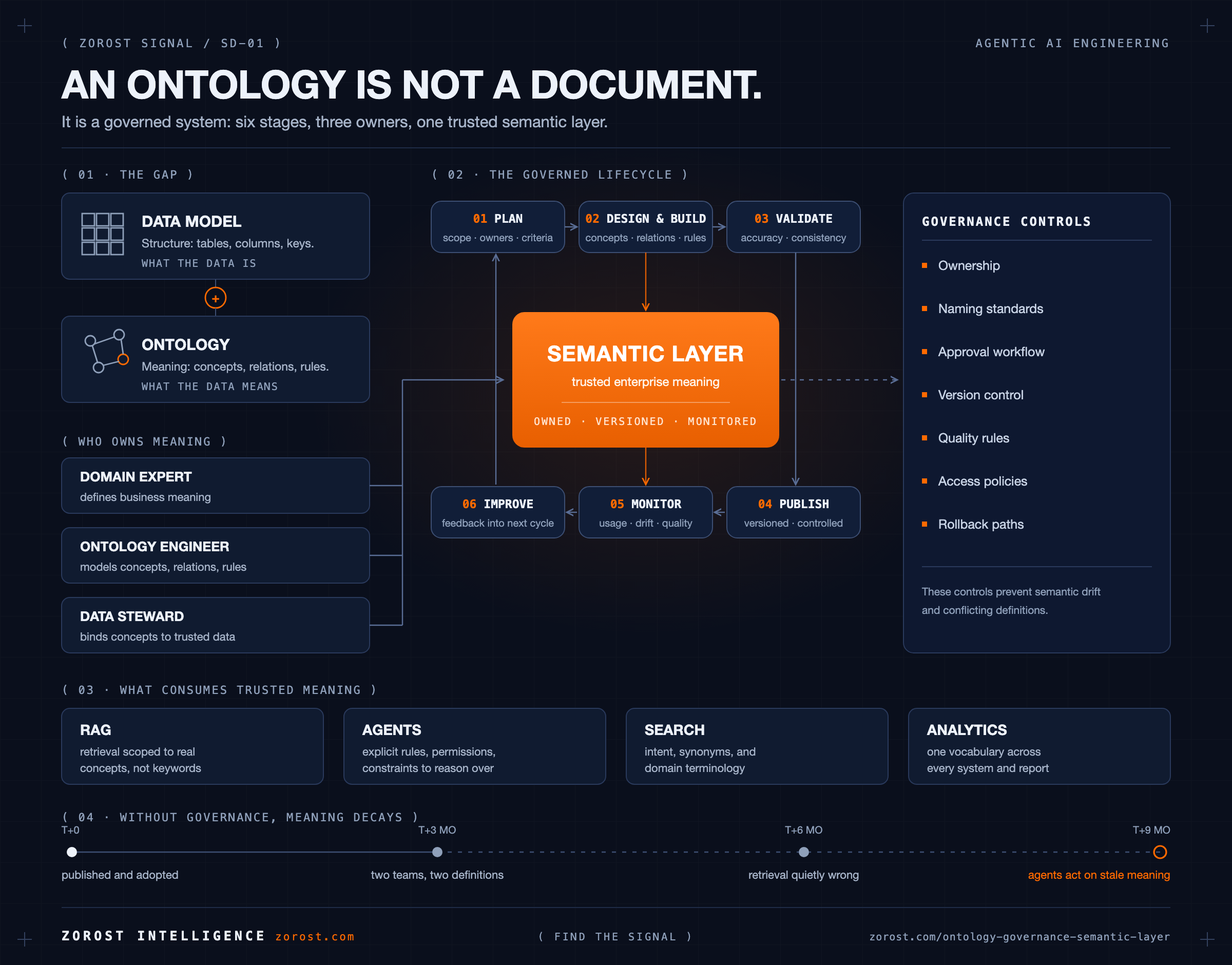
Enterprise AI usually stalls on meaning, not on the model. Two systems can share the same data and still disagree on what a “customer”, an “incident”, or an “active contract” actually is. A data model gives you structure: tables, columns, keys. An ontology gives you meaning: the concepts, relationships, rules, and constraints that let a system reason across those tables. The strongest architecture is not one or the other. It is a data model for structure plus an ontology for meaning, and the ontology has to be governed.
That last word is where most efforts break. Teams treat an ontology as a one-time modeling project: a diagram, a workshop, a slide deck that ages in a wiki. Six months later the definitions have drifted, two teams mean different things by the same term, and the retrieval layer feeding your agents is quietly wrong. An ontology is not a document. It is a governed system with a lifecycle.
The governed lifecycle
- Plan. Define scope, assign ownership, and agree on success criteria before modeling anything. An ontology without a named owner is already decaying.
- Design and build. Domain experts define business meaning, ontology engineers model the concepts and relationships, and data stewards bind those concepts to trusted data.
- Validate. Check accuracy, consistency, completeness, and business alignment before anything is published. Validation is the step teams skip and later pay for.
- Publish. Release it as a versioned, access-controlled asset that applications, analytics, search, RAG, and agents can rely on.
- Monitor. Watch usage, quality, and drift. If applications bypass a concept or agents retrieve it incorrectly, that is governance signal, not noise.
- Improve. Route feedback from users and systems into the next cycle.
Governance controls are what hold this together: clear ownership, naming standards, approval workflows, version control, quality rules, access policies, and rollback. Those controls are what prevent semantic drift and conflicting definitions as the organization changes.
Where a governed ontology pays off
- RAG. Ontology-guided retrieval narrows search to the right concepts and their synonyms, which improves factual, context-aware answers instead of keyword matches.
- Agents. Business rules, dependencies, permissions, and constraints give agents something to reason over, rather than acting on a prompt alone.
- Explainability. Outputs can be traced back to explicit concepts and rules, which is exactly what regulated and federal environments require.
- Integration and validation. A shared vocabulary breaks silos, and ontology rules can flag inconsistent values and broken relationships.
How this lands on a lakehouse
On a modern lakehouse, the semantic layer does not float on its own. It rides on the catalog. Unity Catalog gives you the lineage, access control, and audit trails that a governed ontology needs as its substrate, so “who changed this definition, when, and what depends on it” is answerable rather than tribal knowledge. That substrate is the same foundation our Databricks modernization practice builds on. For federal and other regulated missions, this semantic control layer is what makes an AI answer auditable, not just plausible.
The honest part
Do not try to model the whole enterprise at once. That is the failure mode. Start with one high-value domain where ambiguity is costing you, govern it well, and let the pattern earn its way outward.
How mature is ontology governance in your organization today?