The Pupil: fourteen billion years, then an eye that can ask why.
From first light after the Big Bang to the human pupil, one continuous scroll through the physics that still will not explain itself.
The universe left a record in light: expansion, the birth of stars, galaxies nested inside galaxies, and finally a pupil that can look back. Much of that record is still only partly read. This experiment puts the known physics in front of you as motion you can feel, and asks where machine intelligence can help finish the parts we still cannot close.
The Finding
Lead with the answerThe open problems in fundamental physics are not waiting for prettier diagrams. They are waiting for better search through theories, data, and instruments that no single mind can hold at once. Expansion is measured and still unexplained at the level of dark energy. Most of the matter budget is invisible. The first stars lit a fog we can only partly reconstruct. Gravity and quantum theory still refuse a shared language. AI will not replace the physicist who knows which question is real, but it can already propose candidates, stress them against archives, and surface contradictions a hand search would miss. The Pupil puts the known story of light in front of a viewer so that the unknown parts are easier to name. The finding is simple: the universe still has mysteries, and AI is one of the few tools with the scale to help resolve them, if it is aimed at the physics and not only at the paperwork around it.
The question
What does fourteen billion years of light look like when the physics is felt as motion, and where can AI help with the mysteries that motion still leaves open?
The subject
Cosmic expansion, first light, star birth, nested structure, gravitational lensing of attention, Doppler shift, and the eye that closes the loop.
Not a claim about
A finished theory of everything, a numerical cosmology run, or a substitute for observatory data. This is an instrument for seeing, and an argument about where AI belongs in physics.
Under Test
Stack and environmentThe Account
How it was built and what happenedLight remembers what we still do not.
Nearly fourteen billion years ago the universe became transparent enough for light to travel. That light is still arriving. In it we read expansion, the imprint of early density, and the later glow of stars and galaxies. The record is rich and incomplete. We can measure the expansion rate and still not know what drives its acceleration. We can map galaxies and still not see most of the mass that holds them together.
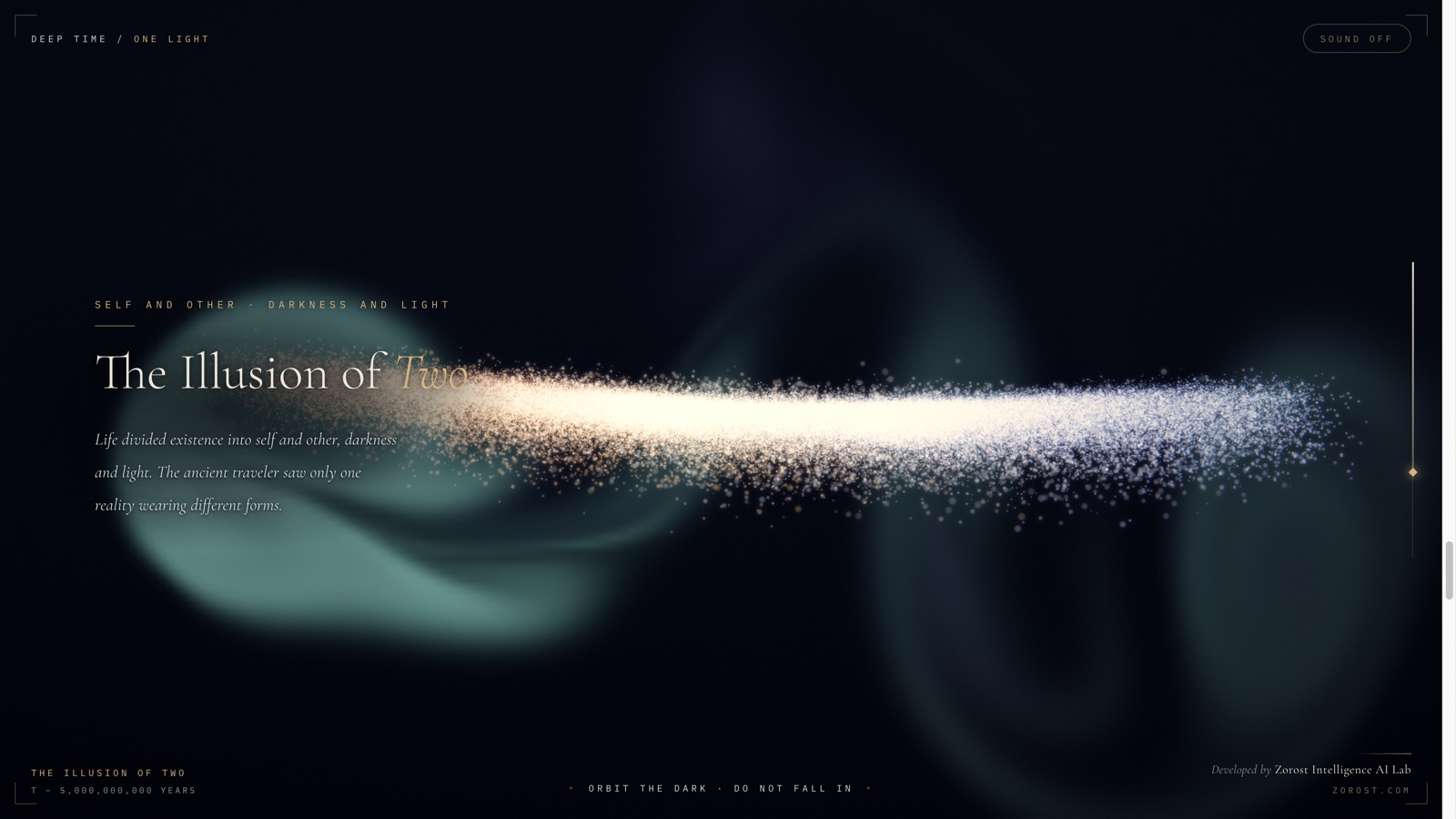
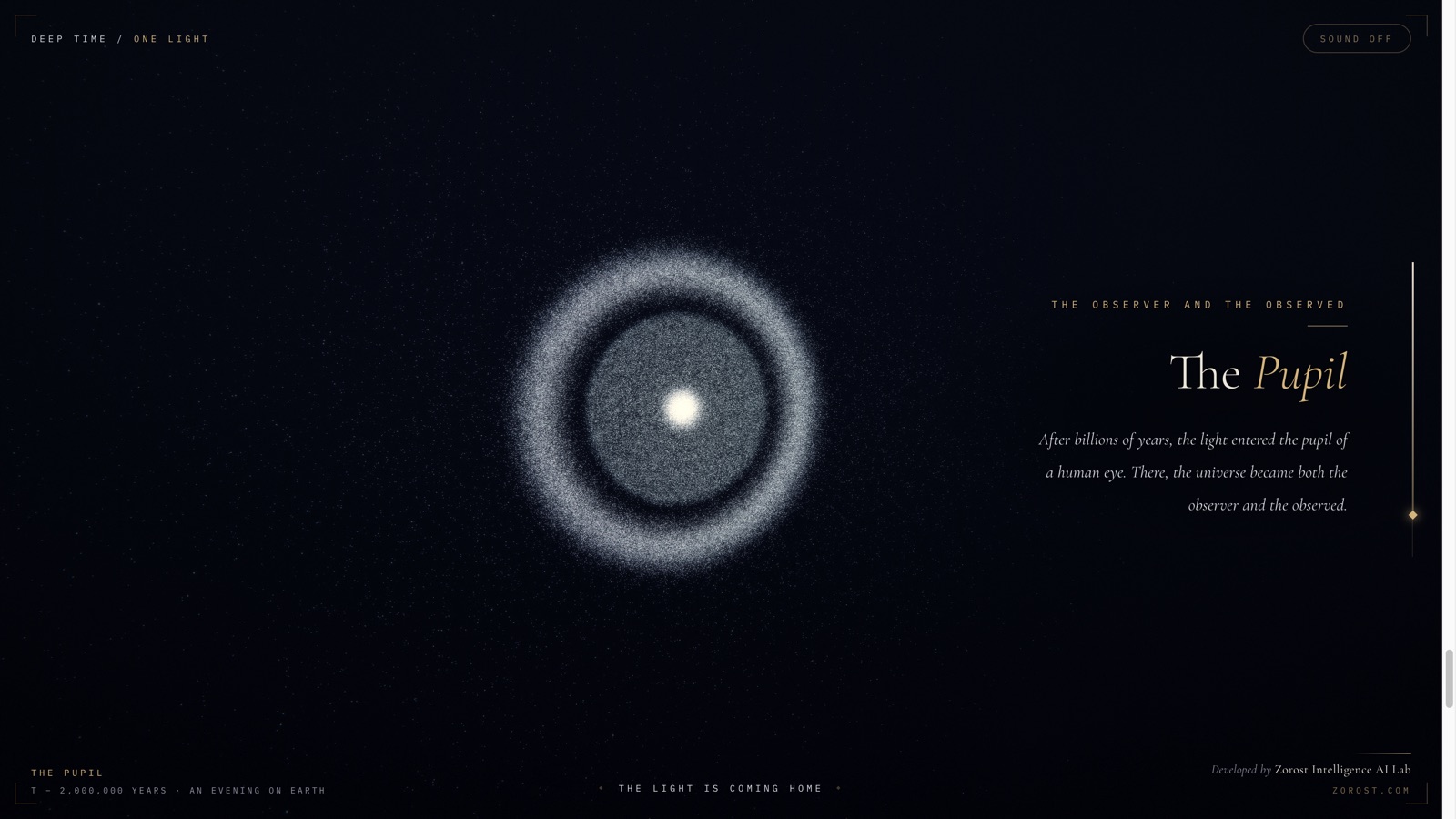
The Pupil is a walk through the parts of that story physics already trusts: first light, expansion, the birth of stars, nested worlds, the illusion that separation is the whole truth, and the pupil that turns the cosmos into an observer. It is also a reminder that trust stops somewhere. Beyond that line the mysteries begin, and that is where new instruments, including AI, earn their keep.
Expansion, fire, and the colour of motion.
Three facts sit under the scroll. Space expands, so distance is not a frozen stage. Stars forged the elements that later chemistry needs, so the night sky is not decoration. Light carries velocity as colour, so a spectrum is a motion sensor across cosmic distance.
Feel those facts before arguing about the gaps. When the field rushes past you, expansion is no longer an equation on a board. When fires gather under the cursor, star birth is no longer a paragraph. When one side of a stream goes gold and the other goes blue, Doppler shift is no longer a definition. The experiment's job is to make the settled physics undeniable in the body, so the unsettled physics becomes sharper by contrast.
- Expansion stretches space and the light that crosses it
- First stars ended the cosmic dark ages and built heavier elements
- Doppler shift turns recession and approach into red and blue
- Gravity gathers structure at every scale the scroll visits
The mysteries the light has not closed.
Dark energy is the name we give to the acceleration of expansion. It is measured in the distances of supernovae and in the large-scale map of galaxies, and it is not understood as a substance or a modification of gravity that everyone accepts. Dark matter is the name we give to the missing mass in galaxies and clusters. It shapes every modern map of structure, and it has not yet declared itself in the laboratory.
Other doors are only partly open. How the first stars formed and died is constrained by theory and by the oldest light we can catch, not finished. How quantum fields and spacetime share one description remains the longest unfinished sentence in physics. How life, and then mind, fit into a physical universe is not a solved chapter either. Naming these cleanly matters, because a mystery stated badly attracts noise, and a mystery stated well attracts the right tools.
Scale for a sky that outruns a single career.
AI does not replace the judgment that decides which question is worth years. It changes the size of the search a careful team can run. Models can propose theoretical forms and check them for consistency. They can scan survey catalogs, transient streams, and gravitational-wave archives for rare or weak signals. They can stand in for expensive simulation steps when the surrogate is validated, so a researcher spends time on the edge cases that matter.
Used that way, AI is not a oracle for the universe. It is a force multiplier on the work physics already knows how to do: generate candidates, confront them with data, discard what fails, and keep what survives. The Pupil ends in an eye for a reason. Looking is the oldest scientific act. AI becomes scientific when it helps that looking reach further than unaided attention can.
A way of seeing, not a substitute for the sky.
This is a visualization guided by real physics, not an N-body cosmology or a claim about how structure formed in detail. No observatory catalog was replaced by a picture. No dark-matter detection is implied by a glowing ring on a screen.
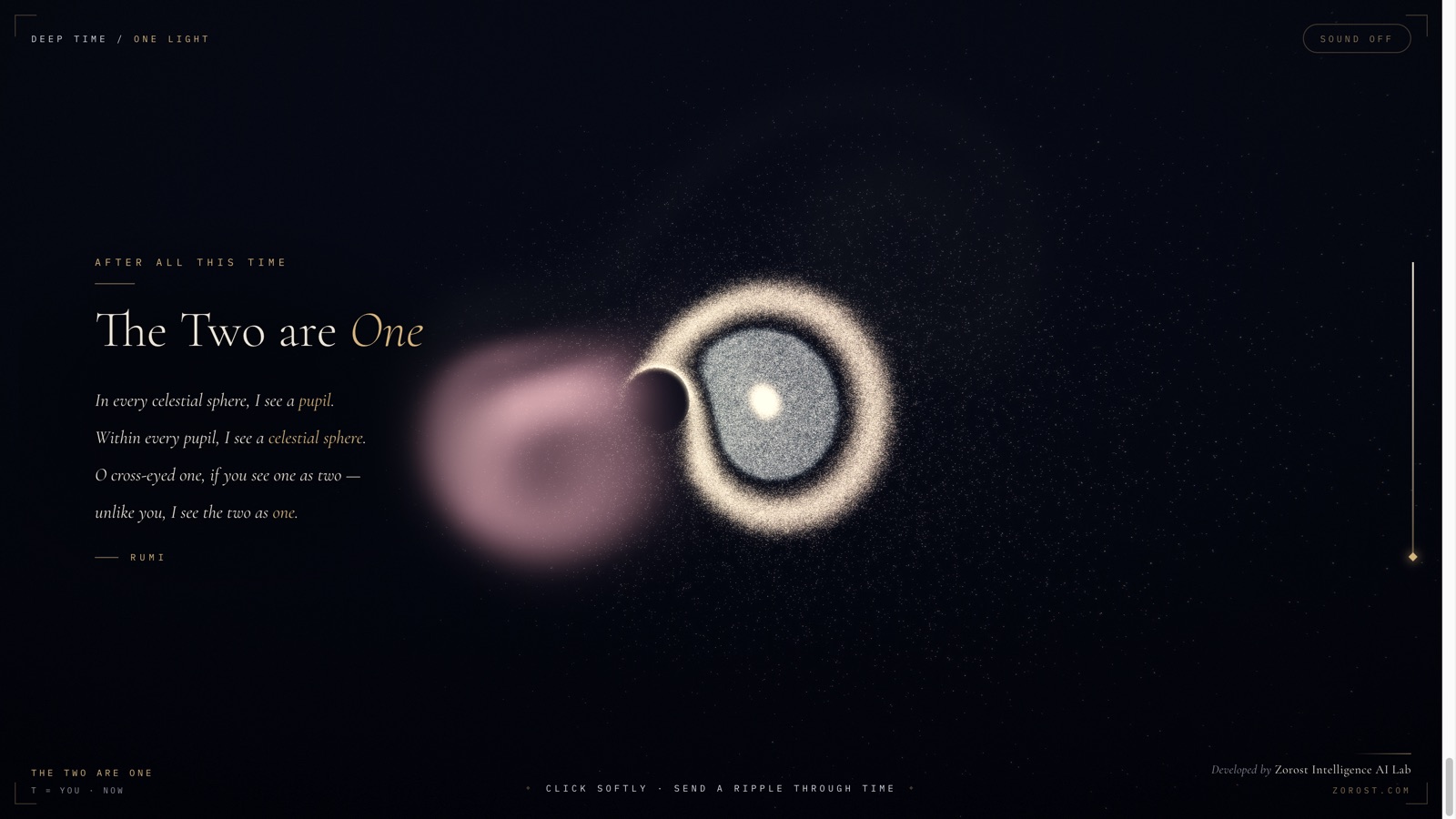
The closing verse is older than modern cosmology. It is here because the loop the physics describes, light leaving the early universe and arriving in a pupil, is also a human fact. The science and the verse ask adjacent questions: what the cosmos is doing, and what it means that something inside it can ask.
From the Field
Captured from the live build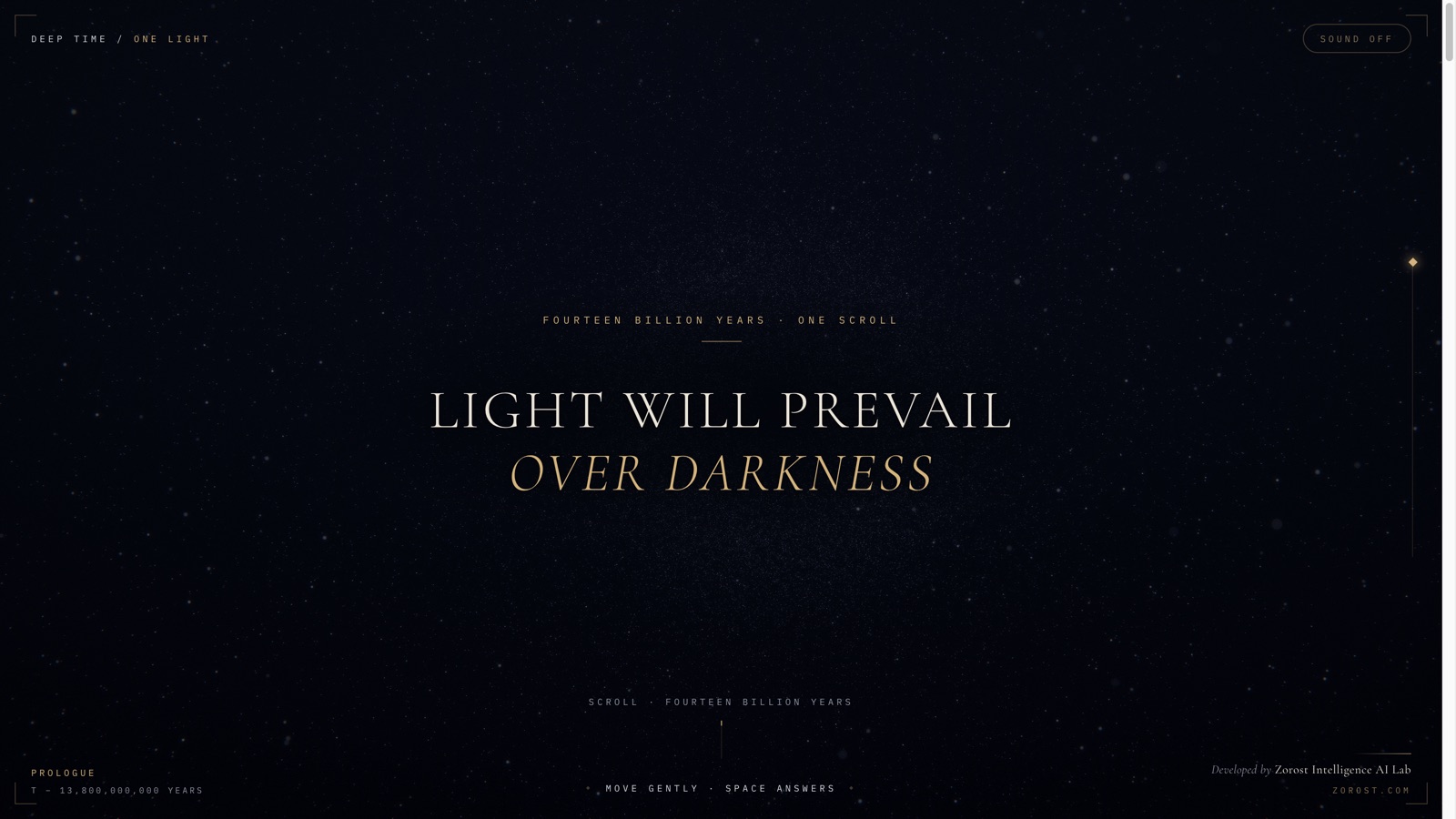
What Held, What We Flag
Wins and limits, side by side- Expansion, first light, star birth, nested structure, and Doppler shift are presented as lived motion, not only as definitions.
- The open problems stay named as open: dark energy, dark matter, early star formation, and the unfinished link between gravity and quantum theory.
- AI is framed as a tool for theory search, archive-scale analysis, and validated simulation support, not as a replacement for physical judgment.
- The experiment keeps a clear border between visualization and scientific claim.
- Reduced-motion preference is honoured, sound stays off until asked for, and a browser without WebGL2 receives a plain message.
- This is a visualization guided by physics, not a cosmological simulation. There is no N-body solver and no claim about how structure actually formed in detail.
- No observatory measurement is replaced by the images on screen. The piece teaches orientation, not catalog values.
- AI can widen search and analysis; it does not, by itself, settle dark energy, dark matter, or quantum gravity.
- The scene responds to a pointer, so cursor gravity has no keyboard equivalent. Scroll, sound, and reading remain reachable from the keyboard.
- WebGL2 is required. There is no 2D canvas fallback, only a message.
Measurements
Enforced on every build- Cosmic age in the scroll
- About 13.8 billion years, prologue to the present
- Scenes
- 8 continuous chapters from first light to the pupil
- Physics made tangible
- Expansion, star birth, gravity, Doppler shift
- Open mysteries named
- Dark energy, dark matter, first stars, quantum gravity
- AI role argued
- Theory search, survey archives, simulation surrogates
- Scientific claim level
- Visualization and argument, not a data product
The universe still has open problems. AI belongs on those problems.
Disclosures
What a careful reader deserves- Everything renders in the browser. The experiment collects no analytics, no location, and no personal data.
- The scenes are physically motivated visualizations and are not a scientific simulation or a source of cosmological fact.
- No astronomical photograph is used. Every image in the experience is generated at run time from point geometry.
- The closing verse is attributed to Rumi and is presented as text, not as a translation of record.
- References to AI in physics describe a research direction, not a shipped discovery or a vendor endorsement.
Questions, answered
The Pupil · common questionsIs The Pupil a scientific simulation of the universe?
No. It is a visualization guided by real physics: expansion, first light, star birth, gravity, and Doppler shift. It is built to make those ideas felt, not to replace observatory data or an N-body cosmology run.
What mysteries of the universe does the piece point toward?
Dark energy and the acceleration of expansion, dark matter and the missing mass in structure, the still-incomplete story of the first stars, and the unfinished link between gravity and quantum theory.
How can AI help with those mysteries?
By widening theory search, scanning survey and transient archives at scales a hand pass cannot, and standing in for costly simulation steps when the surrogate is validated. A physicist still decides which question is real and which result survives.
What should I do in the live experiment?
Scroll through the eight chapters with sound on if you can. Move the cursor to feel a local gravitational field. The piece is meant to be read with the eyes and the hand, not skimmed as a gallery.
Go Deeper
Run it · read it · build on itServing those who
need to stay ahead.
We don't pitch slide decks. We show you what we've already built in your domain, then engineer what your mission requires.